I belong to several groups on Facebook and these groups are great resources for learning what is new and what is out there. Although I see that people tend to ask the same questions and we want to see examples of how people use their Hobonichi as a planner.
While many English users of the Hobonichi state they do not see the Hobonichi as a planner, they see it as a journal, I happen to think it is the best for planning. You get plenty of space in a lightweight, compact format. At the end of the year, if you keep your planners, you have one book to archive. All the pages are bound together so you don’t have to worry about loose pages that can be lost. The format really is a shell, so you can change the format to one of your dreams, and if your needs change the next day, you can change it again. It is beautiful with just words on the page and it is beautiful when artistic elements are added. As the Hobonichi developer said, it is a park and each person can make it specific to them.
Hobonichi on Social Media
 Social media is a great resource for gather different ways of using the Hobonichi as a planner. Facebook, Instagram, and YouTube are my go to choices. Tumblr and Pinterest are other places to look for inspiration.
The three groups on Facebook that I really like for inspiration are: Hobonichi Strictly Planning, Hobonichi Users, and Fauxbonichi Journalers. Since I use somewhat of a bullet journal format in my Hobonichi, Bullet Journal Junkies is another group where I gain inspiration.
Instagram also has a pretty developed community of users and you get to see the range of Hobonichi uses. Tags to search for: #Hobonichi, #Hobonichisp, #HobonichiCousin, #HobonichiPlanner. I’m @momofcurt on Instagram and I use my Hobonichi as my planner and that is how I feature it when I post about my Hobo. @choosingbliss has great posts on how she uses her Hobonichi. Other users I recommend: @tinkerworld, @kristinatheengineer.
YouTube is a great resource for Hobonichi, though it is difficult to find channels that use the Hobonichi as a planner. I really like how the VeganOrganizer, FroggiesTN, TheSassyPineapple, ScrapJoy, OhaiJoy, BiancaNDM, and PoochieBaby display the use of their Hobonichi as a planner.
Personalizing the Hobonichi
The Hobonichi can be whatever you want it to be. It can be thin or chunky. It can be sophisticated or whimsical. It can be moderate or expensive. It can be decked out or plain. It can house journaling, art, or planning. It can even house all three. It can be used as a notebook, project planner, or tracker. The options are endless and are only limited by your imagination. This really is a book that can be all things to all people (I am bias of course. Some people have not fell in love with the Hobo as I fell in love with mine).
Covers for the Hobonichi are more numerous than the uses. Hobonichi sells covers for their Hobonichis that change each year. This means there is an endless line of designs and styles for all sizes. etsy and eBay are other places to look for Hobonichi covers. You can get covers made of leather or fabric. You can even find covers that are no longer being sold on the Hobonichi site. AliExpress sells covers at relatively inexpensive prices. Searching for refillable A5 journals on Amazon will present you with some options. Traveler’s Notebook designers are also starting to design covers for the Hobonichi. I have one from FoxyFix that I am anxiously waiting to receive. Even your local stores have options: Barnes and Nobles, Staples, Walmart, and Meijer have refillable planners and journals that can house the Hobonichi Cousin. Midair MD, Filofax Flex, and Franklin Covey wire bound are other places to look. You can even leave your Hobo naked. The Hobonichi Planner (English version) is especially amenable to this idea with its gorgeous black cover. While the cover of the Cousin isn’t visually pleasing, it can be made into something beautiful through painting, Modge Podge, or contact paper.
Tools for the Hobonichi
Many tools and toys are created for the Hobonichi, but all you really need is a pen or pencil. What is amazing about the Tomoe River paper is it can take almost anything that you can throw at it. While many pens may shadow, few actually bleed through. Copic markers are notorious for bleeding through the page. The paper can withstand a variety of inks, but patience (or a blotter) is essential due to longer dry times to prevent smudging. I recommend using one of the pages in the back as a ink test page. This is where you can really see what your Hobo can handle. If you search ink test, you will find many people that have already done much of the testing for you.
Hobonichi makes some great “tools and toys” for their books. The stencils for me are a must have. As a matter of fact I now have two complete sets of stencils for both of my Hobos and a third green stencil for my Traveler’s Notebook. The Midori Brass rulers are another great option. If you search for Bullet Journal stencils on etsy, you will find some options that may work for you (be careful, sometimes the stencils are actually quite large-think wide ruled notebook paper).
A search on etsy will present you with unlimited options of tools for the Hobonichi. Atelier Dreams makes wonderful stamps. Sweet Kawaii Designs makes fabulous stickers. You can find washi tape in every size and design you could imagine. Other places you can look are the stamps from Studio l2e, Sakuralala, and Marion Smith Designs.
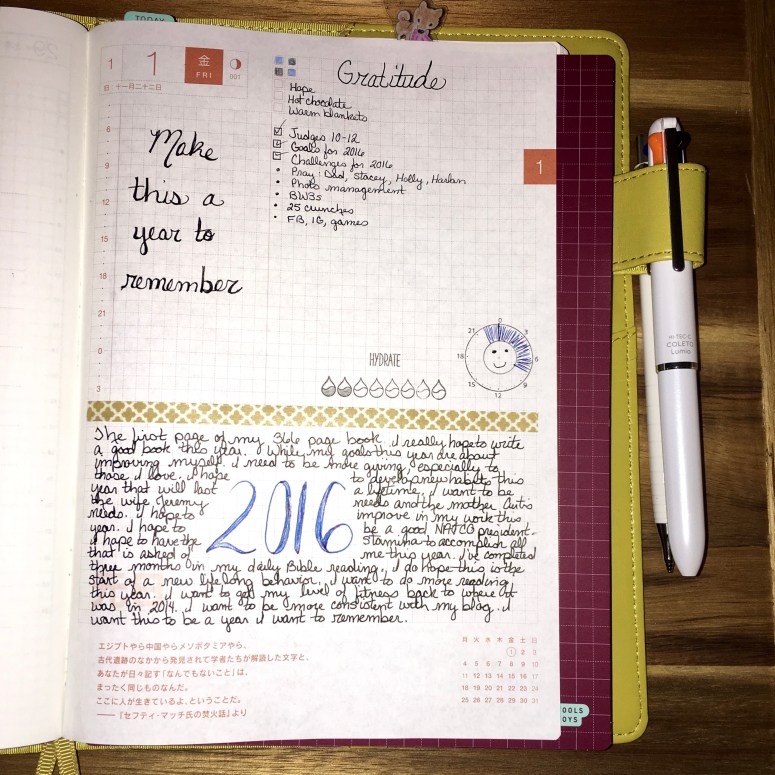
My go to items: Coleto four barrel pen in 0.38, mechanical pencil in 0.38, TWSBI mini with extra fine nib, Noodlers xfeather ink and Diamine Ox Blood ink, Hobonichi clock stamp, Studio l2e and Atelier Dreams stamps, Prima chalk ink, and skinny washi tape. My planner is my planner. The washi tape is functional, it visually divides the two sections of my Hobonichi. The stamps are functional, they are how I track certain items. The pens and pencils, they are what brings me joy while writing.
Types of Hobonichi
The Hobonichi site does a great job of explaining the differences between the various Hobonichis. I have the Hobonichi Planner (x2), Hobonichi Cousin, and Hobonichi Weeks. I will start with the Weeks. It is a great size and great format, but it just isn’t me. Two years ago this would have been perfect. Two years ago I had less responsibilities. Now I use a separate work planner (Filofax Malden) that I will do a review on someday. So until two years ago, I mainly just had to keep track of a few meetings, Bible Study, and my son’s practices and games. I have more that I am responsible for that isn’t specific to work, so I need a different format. The A6 Hobonichi comes in the original and Planner. The Planner is the English version and the grid is a little larger than the Japanese versions. Note, the green stencil does not line up perfectly in the English version, but you can still make it work. The Cousin is the only Hobonichi that has the yearly view, monthly view, weekly view, and daily view. It has the same grid size as the original, so the green stencil works perfectly! If you want to split up your years, Hobonichi also has the avec versions.
My use
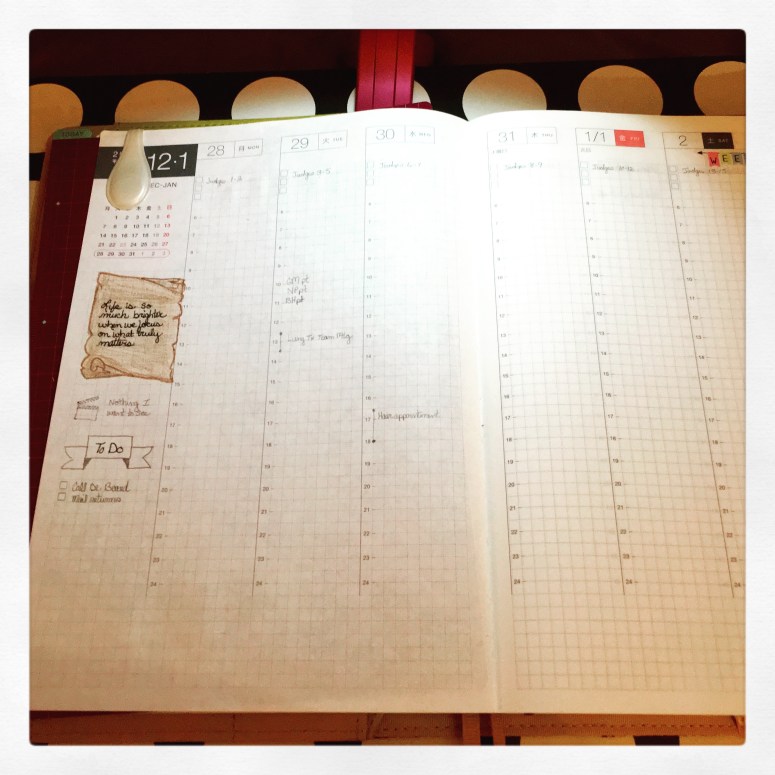
My last blog post about my 2016 setup I go into detail about how I will use my Hobonichi Cousin. Two weeks later and this setup is still working quite well. I chose the Cousin this year because of the additional responsibilities that will be added to my year. The A6 works perfectly for me as well with the addition of the A6 Weeks book. I do have artistic elements in my Hobo. They are mostly function (washi and stamps). However the extra space I will use to practice drawing, stamp images to color, or practice watercoloring. Outside of my monthly pages, I do not decorate in advance, all decorative elements are added after.
For now, I have found my planner love. This is of course always subject to change, but I am on my third month and I am still pleased. Fortunately in today’s planner world, we have many options for when our tastes and needs change.
I am sorry for the exceptionally lengthy post. My goal is to help anyone that is looking into the Hobonichi. I am still somewhat of a newbie (2016 is my second year), but hopefully the newness helps me remember the questions people ask. Have a beautiful day and week.
Danyel



 My organized life